
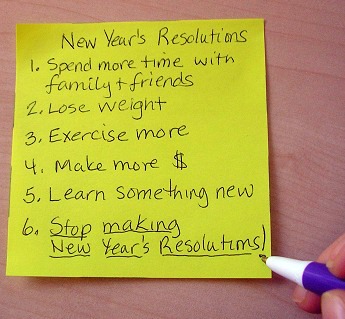
 This is the time of year when people all over the world come up with their own personal resolutions, well-meaning as they are, meant to help them change things in their lives that are unsatisfactory to them for whatever reasons. Some of the most popular resolutions deal with body image, with emotional issues, and with organization, which all make sense because those are the same issues that a majority of human beings struggle with. But too many people take too much time focusing on the resolutions, on creating their list and making sure it’s numbered properly, that they lose sight of the other half of the equation: implementation of the plan.
Resolution: A decision or determination.
Implementation: The act of putting into effect.
It’s ironic that so many people resolve to be more organized, and implementing those resolutions is one of the biggest organizational tasks that can be undertaken. That’s precisely why usually even with such big hopes most people crash and burn when it comes to carrying out those gargantuan tasks they’ve set forth for themselves. Think about the resolutions you yourself have made over the years, and let me know how many of them were successful. Even thinking about my own, it’s difficult to pinpoint the ones that haven’t fizzled after a few days of fervent resolve. And that’s because life often gets in the way.
I know, it’s funny to hear that. After all, these resolutions ARE the epitome of the new life we’re trying to create for ourselves. How can life possibly get in the way of our heaven sent plans? The answer is so easy it might just astound you. We spend so much time those first few days focusing so much on our “new” life that we forget we have one that is waiting in the shadows for us to falter, and then swoops back in to reclaim us as its own. It’s really subtle at first, too. For example, one of my resolutions last year was to exercise more, and to that end I began a custom-made regimen on Wii Fit. It lasted all of two weeks (my personal record). Then life intervened.
 You see, as time went by, and I was becoming acclimated to my “new” schedule of working out, I stopped doing a lot of things I had done previously. I stopped writing as much, and I avoided some of the foods that I knew had helped get me out of shape in the first place. But slowly and surely, I began writing more, and I started adding those foods back into my diet without even realizing it. That’s because as much as I thought I had changed my ways and routines, all I had done was take an extended vacation from those routines, and my internal system phased them right back in without me even knowing. Before too long I was back to not exercising, to eating whatever I wanted, including those fatty foods, and I didn’t even realize things had shifted back.
It’s what I like to call “regression to the established norm,” and it’s a valid hypothesis to explaining why so many resolutions go awry. When there’s no solid implementation of real sweeping change, when there’s just a resolution with no true end goal and established plan to get there, it’s way too easy to return to the status quo prior to those resolutions. So, let’s make a plan this year. We aren’t going to make resolutions that require seismic shifts in our thinking and in our activities. We can stair step them throughout the year that way, so that by the time we’re really doing what we set out to do it has been a while coming, and we have dealt with the setbacks along the way. Because there will be setbacks; no system is perfect.
Resolve with me to work your resolutions in stages, and by December we’ll be celebrating together with some streamers and cake.
Sam
 Sam's Online Journal
Saint-Exupery has it wrong.
A goal is the very beginning of a plan.
I think many new years resolutions fail because new years is when we’re supposed to make resolutions, regardless of whether we’re ready to or not.
I think a goal is what you make of it, which can be a beginning of a plan, or simply markers along the way. I agree that a lot of resolutions fail because we’re “supposed to” make them at a specific time, but we also have time to prepare for them. The odds of resolutions being met don’t necessarily go up just because we may make them at other points in the year, though. It’s about the individual making the resolution more so than about the actual resolution itself.