
In William Shakespeare’s epic tale of hate (and some infatuation as well), Romeo and Juliet, he paints his title characters as ultimate victims of fate. Indeed, in a famous line in Act III, the hero himself (and I use that term loosely) utters the following phrase, “O, I am  fortune’s fool.” This aligns himself utterly with the opinion that he isn’t in control of his actions, that fate has tripped him up. In fact, this is supported by the fact that he has just killed a man he had sworn to love only two scenes before. This actually maintains the thrust of Romeo’s primary character trait, his impulsivity, combined with an inability to take responsibility for what is his own doing, and nothing more. Every time I read the play (and I’ve read it about 100 times with my English classes alone), I often think about the validity of his claim, whether or not fate can be to blame, whether or not fate is real.
“He seems to suggest that a certain path is preordained, that human beings cannot venture off of it even if they try.”
In the Bible, God even has mention of fate, saying that human beings have the power of choice, that this separates us from the animals. Yet, in other places, most notably in Daniel’s dreams, He seems to suggest that a certain path is preordained, that human beings cannot venture off of it even if they try. Nebuchadnezzar does try to break the truth of what he hears from Daniel’s vision, but he does not succeed, even having prior knowledge of what is to come. So, which is it? Are things preordained, or can we change what is to come?
The premise behind the film Back to the Future also deals with this theme of shifting or  changing the future, even if it has been laid out seemingly in stone. Marty McFly changes his own destiny when his mother becomes infatuated with him instead of with his father. Then he has to circumnavigate the carnage he has caused, and bring things back together. In this scenario, the power of choice can and does change what was believed to be certain destiny, with disastrous effects. So, should we be allowed to choose what happens to us, or should fate just decide and we get carried along with the crashing waves? The great Greek philosopher Theodicus has this to say about fate: “The glory of the human condition is our ability to change to suit our situation.”
“Fate is the belief in a power outside of ourselves manipulating us like puppets for ludicrous, or misunderstood, purposes.”
Today I ate two fortune cookies, and I realized it would be the perfect opportunity to observe fate in its natural setting. Simply put, many people put faith in fortune, and some even believe that what is inside their fortune cookies means something important, similar to following the horoscope readings as if they were science. Anyway, my first fortune read, “PART OF THE JOY OF A VACATION IS GETTING THERE — HAVE FUN.” Well, I think first off that this isn’t really a fortune, just a saying. I agree with it, but I’m wondering who was working at that Chinese restaurant who thought this was a fortune. On to the next one. “YOU TEND TO RAISE THE SPIRITS OF THOSE AROUND YOU.” Now, this is rather fortunate. I wouldn’t be able to live with myself if I thought I was making people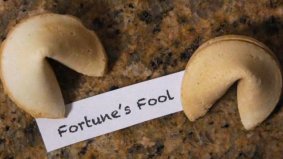 around me miserable. This might be categorized as a fortune, as it may be talking about future spirits I will be able to raise. It might also be self-fulfilling prophecy because it serves to remind me that that’s the effect I wish to have on others.
Oh, and Romeo was wrong. He isn’t fortune’s fool. He’s just a fool who thinks he doesn’t have to take responsibility for his own impulsive actions, and in the end it catches up with him. Do you believe in fate?
Sam
 Sam's Online Journal
I believe we choose although it gets complicated with everyone’s choices all running together. There are some elements that we don’t choose such as our family, our social situation, etc., but we do choose what kind of person we will be.
When God calls a prophet, in a way, that person has less choice, since it is in his best interest to heed the call. However, aren’t we all called, in a sense.
Many are called but few are chosen.
I sometimes wonder if that is not a mis-translation; if it not rather many are called, but few choose to accept.
I completely agree. That freedom of choice is a big one, and so many can’t bear the responsibility.
I used to think of fate as the “destination”…the prize at the end of the game…the handsome prince…the wealth and fortune.
Now I think of fate as the circumstances we rail against…our social standing, our religious upbringing..our nationality, sex, race, disabilities or abilities.
Therefore I think if you are a “fatalist”, then you choose the path of least resistance and let life treat you and take you where it may. 99% of people I know are fatalists.
However, I believe in Destiny. We are all destined for goodness and greatness but we let fate get in our way!
Probably just semantics. Fate seems unempowering.- a way to mitigate personal responsibility. A lazy attitude to justify a lazy lifestyle. Destiny seems more like a dream…a golden ring, an enchanted happy ending. Also a cool mall in Syracuse.
Destiny as a dream sounds amazing, even if it doesn’t ultimately come true. It is the striving for a dream, for your destiny, that makes it worthwhile.