
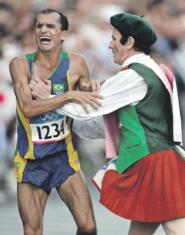
 There he was, leading what was unarguably the biggest race of his career when the unexpected happened. I remember watching it live as it unfolded in real time and just being stunned as Vanderlei de Lima realized a spectator was in the road, tried to escape him, but was instead dragged into the crowd. I had never seen anything like it before, and I never have since. It was so surreal that with security as big as it was for the entire Olympic Games someone could get through the lines and actually put his hands on an Olympic runner in the premier event of the marathon. Less than 10 seconds later, de Lima emerged from the crowd and resumed the race, but his momentum was lost. All of the strategy he had built up gone by the wayside. And I can’t even imagine how much it cost him emotionally. Somehow he was still able to capture the bronze medal, however, a triumph in and of itself. Sometimes you plan, you execute, but things beyond your control derail you. It’s what I call the de Lima Syndrome.
Michael J. Fox was on top of the world. He had a hit franchise in his pocket (Back to the Future), a fantastic TV career (Family Ties), and a wonderful family with his wife, Tracy. Then he began to get tremors in his body, unexplainable and uncontrollable, things that worried and concerned both he and his wife. He soon found out what no one wants to hear. He had Parkinson’s disease, and no amount of acting skill, of money, or of willpower could change that diagnosis. But, just like de Lima, he didn’t let it destroy him. He fought it the best way he knew how, by enlightening the world and by researching how it could be defeated. Like de Lima, he didn’t quit, and he hasn’t quit. Even though the tremors have gotten worse, even when it has gotten very unpredictable from day to day, he has forged on, and he is an inspiration to many, while his foundation for Parkinson’s research has raised a lot of money to aid in finding a cure.
By the same token, Arthur Ashe, the world renowned tennis champion, had a routine heart bypass surgery in the early 1980s that changed his life forever. As dynamic as he was on the tennis court, there was no stopping the demon that infected his immune system because of that operation. Arthur Ashe had contracted HIV, and there remains no cure for it. But, instead of wasting precious time wallowing in misery due to the fatal illness, Ashe used his prominent personality and celebrity to be an outspoken component of AIDS and HIV research, testing, and the search for a cure. While he succumbed to his illness in 1993, his name is still recognized as a foremost fighter in the cause, and the foundation he founded is still fighting for a cure.
But there aren’t just diseases that derail people and throw them off the path they were firmly on, as de Lima proved. Sometimes age just catches up with you. This is especially true of athletes who are deemed to be old at 35 because younger athletes come along and take their positions. It’s also true of movie stars, particularly women, who get older and lose the number of parts they’re offered. It’s not their fault. They just get dragged into the crowd, and unlike de Lima, they can’t make their way back out to even gain a bronze medal.
I remember watching that race and seeing de Lima finish. He seemed somewhat lame, but he was fighting through the pain. He knew he wasn’t going to win, and he knew what might have been, but he wasn’t focused on that. He was focused on finishing the race, and finish he did. When I think of those others who have lived through the de Lima syndrome and have persevered, I take my hat off to them.
Sam
 Sam's Online Journal